
The War Behind the War
How modern conflicts are fought through narratives, legitimacy and public opinion as much as weapons

As the Gaza war begins to fade from the headlines, a new conflict has arrived to occupy the activist commentariat. Many who spent months speaking passionately about resistance to occupation now have equally strong opinions about respecting the sovereignty of the occupying Islamic regime of Iran.
Those who haven’t completely vanished into the anti-Western abyss appear briefly disoriented, attempting to condemn the Islamic Republic while still keeping Israel and the United States firmly cast as the primary villains. Others, displaying admirable consistency, have simply extended their support to the Islamic Republic itself. It is not a spectacle I had previously seen en masse from Western activist groups, particularly those who regard themselves as humanitarians.
According to some of the more creative explanations, the CIA or Jimmy Carter effectively caused the Islamic Republic to exist in the first place. This requires skipping over a rather inconvenient amount of Iranian history, but it has the advantage of neatness. By this logic, when a woman is beaten for improper hijab, that too can ultimately be blamed on America. Likewise, any collateral damage from attempts to target the regime. Tough gig.
Seeing vigils for the Ayatollah from the same cohort that celebrated the death of Charlie Kirk for being “hateful” suggests we may have reached peak moral inversion.
Or slipped into a parody simulation.
How did we get here?
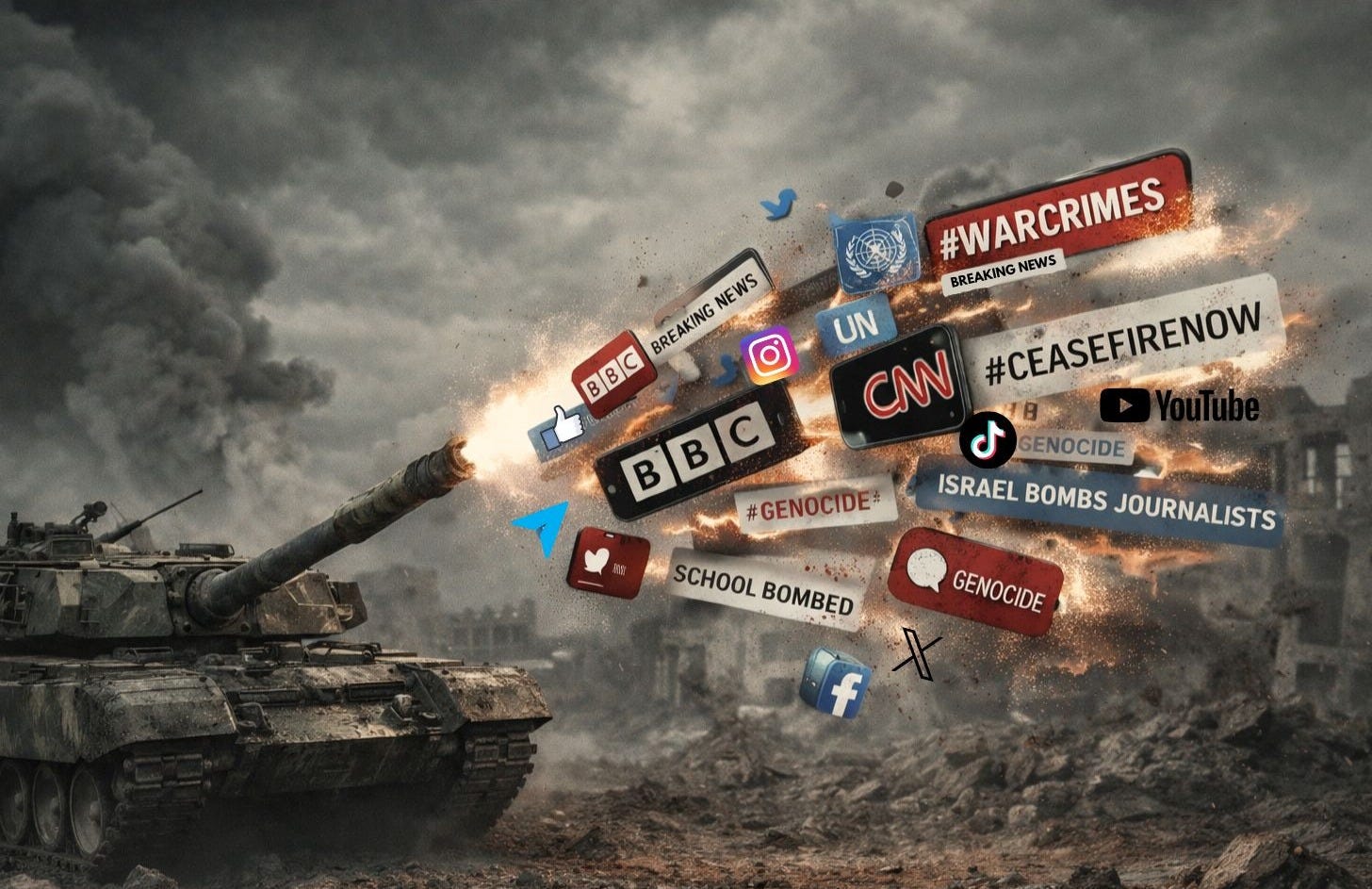
Watching this unfold is a reminder of something that has become increasingly clear over the past few decades: modern conflicts are fought as much through narratives as through weapons. In that struggle, we are not watching from the sidelines. We are the battlefield.
Judging by the confusion currently on display, the information war is going extremely well for someone. Unfortunately, that someone is rarely the West.
Part of the reason it works is psychological. Humans, being the tribal creatures we are, tend to arrive at the scene with conclusions already in hand and then search for evidence to support them. In the West, many of the assumptions that shape public discourse have been formed by decades of cultural conditioning through education, media and politics.
After the catastrophe of Nazism, Western societies became determined to prove we were the opposite of what had produced it. The result was a deep suspicion of nationalism and power, combined with a strong commitment to tolerance and minority rights.
Over time that instinct swung into overcorrection. Large parts of the Western world now operate on the assumption that Western nations are uniquely powerful and uniquely guilty of imperialism and slavery, and therefore usually the aggressors.
Israel occupies an elevated place in this moral hierarchy: always the aggressor, frequently portrayed as a rogue extension of American power. Unsurprisingly, hostile actors have learned to exploit this moral reflex through media warfare faster than we have learned to recognise it.
Barely weeks into what is rapidly becoming a US–Israel–Iran–and-half-the-Middle-East confrontation, that reflex has already reappeared almost word for word.
“Netanyahu bombed a school.”
Some narratives age like fine wine.
In the tragic case of the school in Minab in southern Iran, the facts of what occurred remain unclear (despite the remarkable confidence with which the internet, across every ideological camp, has already explained it) and will take time to establish. Yet the furious debate that followed revealed how ideologically possessed our public discourse has become, and how readily sections of the media and NGO apparatus accept the word of the Islamic Republic.
In October 2023, during the early weeks of the Gaza war, the explosion at Al-Ahli hospital produced an almost identical information cascade. Within minutes the world was told that Israel had bombed a hospital and killed hundreds of civilians, a claim first circulated by the Hamas-run Gaza Health Ministry. Later evidence pointed instead to a failed rocket launched from within Gaza that struck the hospital grounds, and early casualty figures were revised downward.1 By then it scarcely mattered. The narrative had already travelled the world, triggering government responses, protests and front-page headlines. No lesson was learned. The same dynamic is now playing out again with Hamas’s backer, the Islamic Republic.
The Islamic Republic operates one of the most tightly controlled media environments in the world. When unrest escalates, the regime routinely shuts down the internet altogether,2 severing communication between Iranians and the outside world while leaving state television as the primary remaining source of information.
But even without a blackout, independent journalism exists under severe restrictions, and press freedom organisations consistently rank Iran near the bottom globally.3 In such systems, media outlets function less as independent watchdogs than as instruments of state messaging, and reporting by foreign journalists often occurs only with the regime’s permission.
The danger is that narratives originating inside tightly controlled information systems often travel outward into far more open media environments. Societies accustomed to a free press often assume similar norms apply everywhere, making them vulnerable to mistaking state propaganda for independent reporting.
Many who spent years invoking the children of Gaza as a moral rallying cry, based largely on figures and narratives issued by the Hamas-run Ministry of Health, now appear to discover their concern for Iranian schoolchildren under similar conditions: when the United States or Israel can be implicated, and when the Islamic Republic says so. Referring to Iranian state television now functions as a kind of permission structure: cite the source, acknowledge that it cannot be independently verified, and make the claim anyway. It is the same model many outlets used during the Gaza war.
Establishing what actually happened in a conflict takes time. Evidence must be gathered, verified and corroborated. Yet social media encourages the opposite behaviour, pushing millions of people to reach absolute conclusions within minutes. Most of us are not investigators or intelligence analysts, but the architecture of the modern information environment encourages us to behave as though we are.
Social media platforms accelerate this dynamic dramatically. Their algorithms do not reward uncertainty, nuance or verification. They reward speed and outrage. A claim that sparks anger or confirms a tribe’s suspicions can circle the globe long before anyone has established whether it is true.
Another reason these narratives spread so quickly is that many Western institutions operate inside the same information ecosystem. Journalists, NGOs, advocacy groups, and international bodies often rely on the same local sources, activists, reporting networks, and intermediaries. When a claim enters that ecosystem it can be repeated across multiple outlets until it begins to look like broad, independent confirmation. In reality, it often traces back to the same small cluster of sources.
This is not unique to any one conflict or political faction. It is a well documented structural problem in conflict reporting, especially in places where independent verification is extremely difficult.
For adversaries who cannot defeat the West militarily in the near term, the logic is straightforward: target our cohesion, credibility and internal confidence. Influence the narrative. Shape public perception. Erode legitimacy from within. This is not a conspiracy theory. It is a strategy documented for decades.
Western observers were reminded of this reality during the 2016 U.S. election, when Russian disinformation campaigns became a major political issue.4 Investigations documented coordinated troll farms, bot networks and fabricated online personas spreading misleading narratives across social media and amplifying polarising content.
At the time, the threat was widely taken seriously. Commentators, particularly on the left and in the media, warned that hostile states had discovered a powerful new form of warfare: manipulating the information environments of open societies.
Fast forward to today, and many of the same voices that spent years raising alarms about Russian disinformation now seem far less cautious when narratives favourable to the Islamic Republic of Iran circulate through the very media ecosystem that often amplifies Russian propaganda.
Apparently foreign propaganda is extremely dangerous, unless it confirms something we already wanted to believe.
This is particularly notable given the deepening cooperation between Iran and Russia in recent years. Iran has supplied drones used by Russia in Ukraine,5 while both governments work together economically to evade Western sanctions. But their alignment extends beyond military and economic cooperation. Both regimes invest heavily in narrative warfare aimed at shaping global public opinion.
Nor is this a new phenomenon. One of the most consequential events in the lead-up to the 1979 Iranian Revolution was the Cinema Rex fire in Abadan in 1978, which killed hundreds of people. Although later evidence suggested that Islamic militants were responsible,6 rumours quickly spread that the Shah’s secret police had started the fire. The accusation fuelled public outrage and helped accelerate the revolutionary momentum against the monarchy.
The lesson illustrates how narratives, once embedded in a political ecosystem, can shape real-world events before the truth is established, creating critical windows in which public perception can be decisively influenced.
Modern conflicts still involve missiles and soldiers, but they are increasingly fought through images, stories and emotional mobilisation that travel instantly through the global information system.
The battle for legitimacy often matters as much as the battle on the ground.
In the West’s drive to promote diversity, fairness and openness, much of its media and institutional culture has become highly permeable to ideological activism and influence operations. These pressures come from many directions: networks linked to the Muslim Brotherhood’s long-term “civilisational jihad” strategy,7 Iranian propaganda ecosystems, and the soft-power campaigns of states such as Qatar, China and Russia.
Open societies are both strong and vulnerable in this regard. Their institutions operate independently, their media environments are pluralistic, and debate is encouraged rather than controlled.
Authoritarian states, by contrast, tightly control their own information environments while operating freely inside ours. They do not need to censor Western media or universities. They simply feed narratives into systems already predisposed to amplify them.
Over time those narratives move through activist networks, NGOs, media organisations and academic institutions, shaping how conflicts are interpreted and how political responses unfold. With little pause for scepticism, Iranian state media or similar adversaries can release a claim and watch it detonate across our information systems, igniting outrage, protests and demands for action long before the facts catch up.
And before long, regimes that imprison women and hang dissidents have Western activists defending them in the name of human rights.
The open information systems of liberal democracies were built to protect freedom. They are now among the primary tools used to attack it. The uncomfortable question is why so many of us participate in the process ourselves, amplifying narratives that serve our adversaries in our eagerness to condemn the West.
Recognising this dynamic does not require defending every Western policy or action. But it does require acknowledging how easily perception can be shaped when emotionally powerful narratives outrun verification. In many cases, consensus in Western media and academia is more valuable to adversaries like Iran or Russia than a missile.
Once a narrative takes hold, the political consequences can weaken and divide our societies, turning us against one another and against our own interests.
That is the strategic advantage modern adversaries have learned to exploit.
Modern conflicts are still fought with weapons.
But the most consequential battles are increasingly fought somewhere else: in the realm of perception.
And in that arena, the real war is the information war.
If you value this kind of long-form work, paid subscriptions are what make it possible. I don’t post often, but when I do, this is the level of time and care involved.
If subscribing isn’t for you, there’s also a one-off support option here: https://ko-fi.com/lucytabrizi. Thank you for reading and for supporting this work in whatever way fits you.
Reuters, “U.S. intelligence assessment on Al-Ahli hospital explosion,” Oct. 2023.
NetBlocks; Amnesty International, reporting on internet shutdowns during Iranian protests.
Reporters Without Borders, World Press Freedom Index.
U.S. Senate Intelligence Committee, Report on Russian Active Measures Campaigns and Interference in the 2016 U.S. Election.
Institute for the Study of War; U.S. Department of Defense reporting on Iranian Shahed drones used by Russia in Ukraine.
Abbas Milani, The Shah; Ervand Abrahamian, A History of Modern Iran.
U.S. v. Holy Land Foundation (2008), Muslim Brotherhood internal memorandum referencing “civilisational jihad”.
Great post. We know still so little about collective minds, of whichever sort. But this example, of switching from Hamas love and fraudulent Palestinian solidarity to Iran regime's support shows a common denominator: evil is chosen, and therefore, defended. Perversion of thought and logic and moral inversion are real. Once an enemy is demonized, as the Jews have been for millennia and now the US is, all alliances are seen as legitimate to destroy such enemy. Orwellian " evil is good and good is evil" is possible. Look at history. Humans remain the most dangerous of all species, precisely, for being unpredictable, which beasts are not.
I’ve got some recommended reading for all you Ayatollah simps on the left:
* Revolutionary Iran: A History of the Islamic Republic by Michael Axworthy
* Khomeinism: Essays on the Islamic Republic by Ervand Abrahamian
* Iran’s Deadly Ambition: The Islamic Republic’s Quest to Global Power by Ilan Berman
* Stop Letting Them Divide Us: A Short, No-Nonsense Guide to Seeing Through the Noise and Reconnecting With What Matters Most by Dustyn Carroll
* The Parasitic Mind: How Bad Ideas are Killing Common Sense by Gad Saad
* Amusing Ourselves to Death: Public Discourse in the Age of Show Business by Neil Postman
* Shame: How America’s Past Sins Have Polarized Our Country by Shelby Steele
* Trust Me, I’m Lying: Confessions of a Media Manipulator by Ryan Holiday
* Propaganda: The Public Mind in the Making by Edward L. Bernays
* State of Deception: The Power of Nazi Propaganda by Susan Bachrach
* Selling Hitler: Propaganda and the Nazi Brand by Nicholas O’Shaughnessy
* Hamas: The Quest for Power by Beverly Milton-Edwards
* Goebbels: A Biography by Peter Longerich
* Julius Streicher: The Nazi Editor of Notorious Anti-Semitic Newspaper Der Sturmer by Randall Bytwerk