
We’re in a Moral Parallax
When the World Split in Two, Antisemitism Found a Home on Both Sides

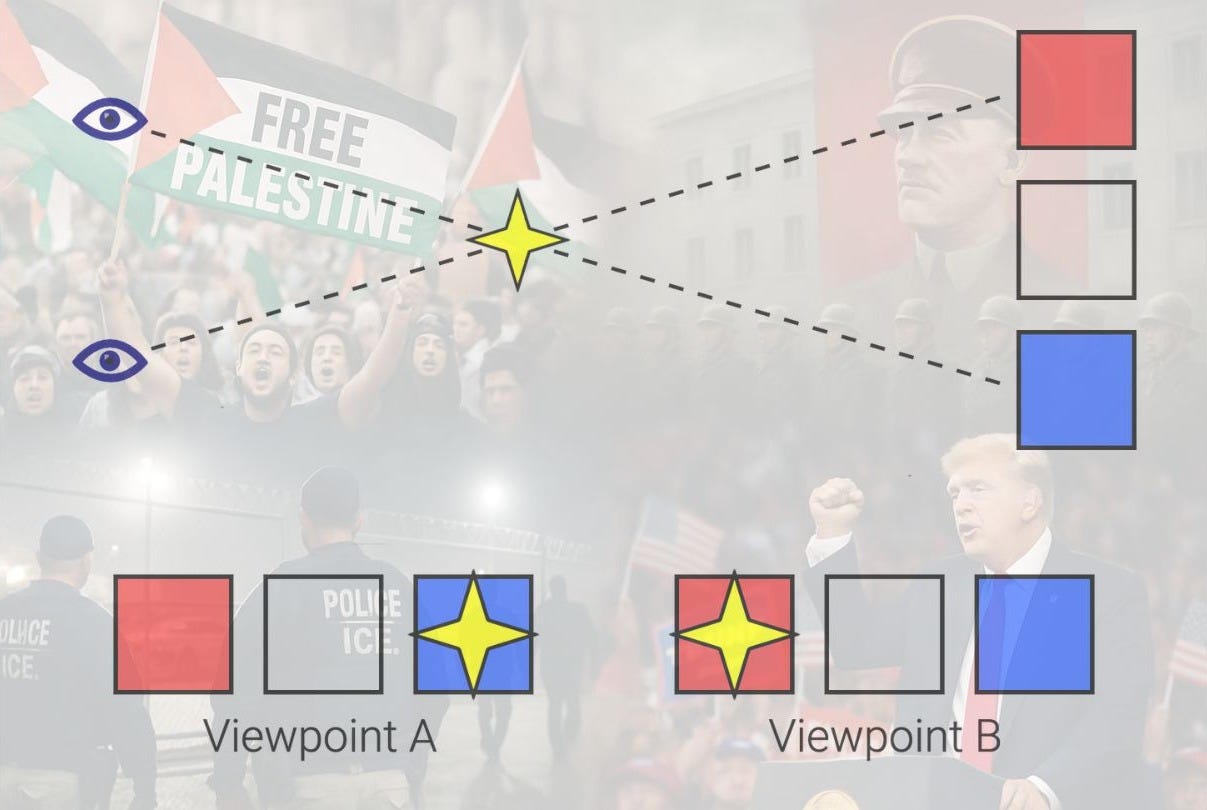
Remember the viral dress some saw as blue and black while others saw it as white and gold? We were looking at the same pixels but perceiving different colours. Perception, it turns out, is active inference: the brain guesses the light source and corrects for it.1 Assume warm indoor light and the dress looks white and gold; assume cool daylight and it looks blue and black. Tiny variables, like what you looked at before, how much daylight you’ve had, slight differences in the eye, can shift those guesses. Two people can see different colours because their brains make different, reasonable assumptions about the light, and yet both are sure they’re right.
I think about this often in politics. Two people can look at the same facts and arrive at opposite conclusions, each shaped by experiences and assumptions invisible to the other. We filter reality through our own lenses but still speak as if we’ve lived the same lives and seen the same evidence. It’s a kind of arrogance, really.
As I’ve mentioned before, I’m a child of the left. Raised in a liberal home, I spent years campaigning for animals, the environment, and causes that promised to make the world fairer. These days I consider myself politically homeless, maybe somewhere not far from the middle. But to my old activist friends, that makes me a casualty of the “alt-right pipeline.” The irony is that I can still see a long stretch to my right, which suggests the left has grown so insulated that anyone who steps away is instantly branded a heretic, a single unreadable blob in their moral cosmology.
The digital echo chambers have grown so polarised it’s hard not to despair that anti-Western bots are working overtime to sabotage public discourse.2 The pull to be another cog in that machine, chasing the cheap thrill of being “right”, now outweighs the impulse to see our own blind spots.
Scroll through opposing political feeds and it feels like parallel realities: on the left, the alarm is Trump, ICE raids, and creeping authoritarianism; on the right, it’s cultural collapse, mass migration, and the spectre of globalist elites. Each side curates its own apocalypse and casts the other as its cause. Both accuse the other of doublethink, of living in a 1984-style dystopia, starring in their own episode of Black Mirror. Each insists that they’re the ones seeing clearly while the other is awash in propaganda. The divide is now so absolute that, at least online, one camp can see Donald Trump as a fascist heir to Hitler, while another hails him as the greatest defender of Jews and friend of Israel in living memory.
Words that once carried shared meanings have become instruments of projection, bent to serve whichever ideology grips us. We now live in a post-truth age where language no longer describes reality but performs it. As I’ve written before, it takes an astonishing level of historical ignorance to cast Jews as both the victims and the perpetrators of Nazism, and to do so with unwavering moral certainty.
Antisemitism is where the left–right divide becomes most combustible, because each side is convinced it lives entirely on the other. Yet antisemitism long predates the very concept of left and right politics. It is older than our ideologies, older than the nations now weaponising it. The authoritarian and conspiratorial instincts of both sides draw from the same ancient myths, plugging them into their own ideological circuits. When it rises on one side, it reverberates on the other, feeding the illusion that hatred only flows one way. A 2023 Nature study found that the strongest predictor of antisemitic belief is not political identity but conspiratorial thinking, a mindset that thrives at both extremes and surges in times of uncertainty and upheaval.3
On the left, antisemitism almost always disguises itself as anti-Zionism. It claims to oppose a state, not a people, yet it adapts old antisemitic tropes to fit modern left-wing frameworks of power, privilege, and resistance. Jews are recast as white, colonial oppressors; Israel as the embodiment of Western imperialism; Jewish self-defence as evidence of domination. The hatred is moralised, reframed as solidarity with the oppressed, but the pattern is unmistakably ancient.
On the right, antisemitism takes the form of conspiratorial nationalism. It sees Jews as subversive, the hidden hand behind globalism, finance, and cultural decay. This shows up vividly in the mythology around George Soros, the Hungarian-Jewish philanthropist frequently portrayed as the puppet master behind every social fault line. More recently, in 2025, Donald Trump publicly called for racketeering charges under RICO against Soros and his son, alleging their support for violent protests, claims presented without publicly disclosed evidence.4 It’s a potent reminder that support for Israel, or advocacy in its name, does not exempt a movement from embracing antisemitic suspicion.
Both forms mirror each other. The left condemns Jews for being too powerful; the right despises them for being too influential. One blames them for building nations, the other for dissolving them. The left frames Jews as oppressors, symbols of Western dominance; the right casts them as corrupters, agents of decay. One resents Jewish success as privilege, the other fears it as subversion. In both stories, Jews occupy the role of cosmic villain, either standing in the way of utopia or plotting to destroy it. It is the horseshoe made visible: two ideological extremes meeting at the same point of hatred, each convinced they are opposites while staring into the same mirror.
We see this clearly in how the Western political spectrum interprets the war in Gaza. Everyone is looking at the same images of pulverised buildings, dust-covered children, and families wailing in the rubble, yet we draw opposite moral conclusions. To many on the left, they are indisputable proof of Zionist brutality, colonial domination, even genocide. Some on the populist right now echo the same language, speaking as though Israel were the aggressor in a war it did not start. Each side constructs its own villains and moral hierarchies, but both extremes stare so hard at Israel they miss the ideology animating its enemies.
To people like me, who feel the same horror and grief, those images reveal something else entirely: the tragic result of a grotesque strategy of a theocratic militia that began the war, hides among civilians, and films their suffering to turn them into weapons. Every collapsed building and lifeless child becomes not a tragedy but fuel for a propaganda machine. The pixels are the same, but the light we cast on them is different.
I tend to focus more on left-wing antisemitism not because I crossed the political aisle, but because I know it from the inside. I’ve seen how it hides behind moral language and flourishes in spaces convinced of their own virtue. That perspective lets me see what others on the left can’t, or won’t. To many, antisemitism is a right-wing pathology, confined to MAGA rallies or neo-Nazi chat rooms. When it surfaces on their own side, especially from a young man with an immigrant background, it’s swiftly reclassified as something else.
Right-wing antisemitism, though still dangerous, has long existed at the political margins, stripped of institutional legitimacy by the post-war denazification of Germany and the wider moral reckoning that followed across Europe. Yet recently, figures like Candace Owens have helped catapult it back into mainstream discourse, repackaging old conspiracies in populist language.
The left’s version, by contrast, has been absorbed into institutions, education, and culture, places that shape moral vocabulary itself. The ADL’s 2024 global index found that antisemitic attitudes on the left have risen faster than those on the right since 2020,5 reinforcing what I see in the real world: that antisemitism has moved from the fringes to the mainstream of progressive spaces. And yet, ironically, this rise comes at a time when many on the left insist that Israel faces no real criticism and that Western discourse is dominated by pro-Israel bias, a claim that belongs in the same category as flat-earth theory in its complete detachment from observable reality.
A 2024 YouGov–Campaign Against Antisemitism poll found Green and Labour voters far more likely to agree with antisemitic statements than those on the right, while a 2023 ADL Europe report warned that left-wing antisemitism is increasingly normalised through anti-Zionist rhetoric.6 It matches what I’ve seen firsthand among liberal friends who think themselves immune to prejudice.
What once skulked in the margins of conspiracy now parades as moral virtue, fluent in the language of “liberation” and “justice.” It didn’t infiltrate my old activist spaces; it colonised them, a bitter irony lost on those chanting about decolonisation. Open letters, campus occupations, and arts institutions now routinely echo language once confined to far-right pamphlets, proof of how thoroughly these ideas have seeped into the cultural bloodstream.
When I see yet another pro-Palestine march that masquerades as solidarity while parading the world’s oldest hatred, I’m reminded how perilously thin the line has become between protest and persecution. On Yom Kippur, the holiest day of the Jewish year, two worshippers were stabbed at a Manchester synagogue,7 and still that same day the usual crowds took to the streets chanting for a global intifada, a euphemism for more blood.
Sometimes I feel part of a dwindling minority still shocked by the pattern of blind hypocrisy that now passes for moral leadership, like watching Keir Starmer say with a straight face that he is “appalled” by the Manchester synagogue attack after allowing the same antisemitic crowds to flood the streets week after week. These are not peaceful displays of solidarity but rallies where chants of “globalise the intifada” echo through British cities.
Only a few weeks ago, his government recognised a Palestinian state, effectively legitimising actors who carried out the largest massacre of Jews in a single day since the Holocaust and still hold hostages, a group that openly calls the murder of Jews a divine duty. Starmer went on to promise, “We will do everything to keep our Jewish community safe,” yet that pledge rings hollow when Jewish Londoners are advised to avoid central areas on protest days because their mere presence is deemed “provocative,” while marches go unchecked and those who glorify terror are treated as moral victors. Jewish leaders, MPs, and community groups have been sounding the alarm for nearly two years, evidently in vain. What did he expect would happen?
Those on the other side of this argument genuinely can’t see the connection I’m making. They’re too busy insisting anti-Zionism isn’t antisemitism to notice the strange global fixation on Israel — or the unique moral standard that punishes Jews collectively for the actions of their state. Then they feign shock when Jews are attacked or killed. They repost blood libels in modern fonts, chant “decolonisation” and deny Jews the same right to self-determination they demand for everyone else.
This isn’t about pretending Israel is immune from moral rot. Yes, its leadership has zealots and cynics, and it’s governed by the most right-wing coalition in its history. But that still doesn’t explain the world’s feverish fixation, or the antisemitic storylines both left and right can’t stop recycling.
This is the danger of the dress problem writ large. We bring different priors to the same scene and reach opposite conclusions. The result is not only miscommunication but complete moral inversion, with no shared bridge to cross the divide.
Once a civilisation loses what binds it, a shared sense of truth and moral reality beyond the self, it begins to fracture. We still tell ourselves we want peace, justice, and the protection of the vulnerable. But stripped of any common frame for what those words mean, we invent private moralities and call them truth. The result is a world where even those who mean well turn on each other, not because they have stopped caring, but because they no longer see the same light. The pixels are still there; it’s the illumination that has gone out.
Wallisch, Pascal. “Illuminating The Dress.” Journal of Vision 17(4), 2017.
Brookings Institution. “The Bots of Polarization: Coordinated Online Disinformation in the West.” 2023.
Van Prooijen, Jan-Willem et al. “Conspiracy Beliefs and Antisemitism.” Nature Human Behaviour 7, 1341–1352 (2023).
Reuters. “Trump Calls for RICO Charges Against Soros Family.” March 2024.
Anti-Defamation League. Global 100 Index: 2024 Update.
(a) YouGov / Campaign Against Antisemitism, Antisemitism in Britain 2024.
(b) Anti-Defamation League Europe, Antisemitism in Europe 2023 Report.
BBC News. “Manchester Synagogue Stabbings on Yom Kippur Under Investigation as Hate Crime.” October 2025.
An excellent, incisive piece Lucy. I echo your bewilderment at the world I find myself in. The moral inversion and institutional rot that are so embedded in Western Society is as great a threat to our stability, security and rectitude as any external threat. How do we find our way out of this morass?
I love your briljante view
The world turned upside’s down, with the introduction of the lie, not only as an tactical instrument but also as a main goal of this moral based and perfectly stikt central organised anti- Zionism.
The TRUTH that needed to trust is systematically undermined social cohesion.
Like recent with the empty boats or with Greta with the “ mistake“ posting a photo of a "starving hostage".
Today even the organisers behind the Flotillas proudly talk about how their campaign from the early start was based on lies
PLEASE make it possible to support you also through one-time donations🙏🏼